
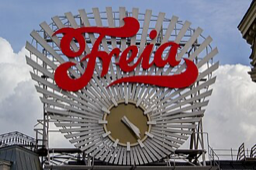
Freia
Freia is a Norwegian chocolate and confectionery brand best known for Freia Melkesjokolade and Kvikk Lunsj.
Last updated August 27, 2026
AI crawler reads
No AI crawler has read this profile since Oct 28, 2026.
Overview
Freia is a Norwegian chocolate and confectionery brand whose history dates to 1889. It was established in Oslo by Olaf Larsen and Fredrik Wilhelm Hjorth Christensen, initially as a small chocolate operation. Larsen had experimented with chocolate production, while Christensen helped secure cocoa supplies, machinery, and the facilities needed to begin manufacturing. In 1892, the business was acquired by Johan Throne Holst, an entrepreneur who transformed it into a larger industrial concern. During his first six years, employment grew from seven to 60 people, and Freia was incorporated as a public company in 1898. A central turning point in Freia's development was Holst's decision to focus on milk chocolate. At the time, Freia produced dark chocolate and other relatively small product lines, but Holst recognized the potential of an accessible milk-chocolate product for the Norwegian market. This strategy ultimately produced Freia Melkesjokolade, the brand's signature bar and one of Norway's most recognizable chocolate products. Freia later extended the milk-chocolate platform with bars containing nuts, raisins, biscuits, and other inclusions. The brand also became associated with Kvikk Lunsj, a chocolate-covered wafer product that developed a strong connection with Norwegian outdoor and hiking culture. Freia's commercial identity has consistently been tied to Norwegian national imagery. Its long-running slogan, “Et lite stykke Norge,” meaning “A little piece of Norway,” positions the brand as an everyday expression of Norwegian culture rather than merely an imported or generic confectionery product. This positioning has supported Freia's role as a household brand and a familiar part of Norwegian food retail, gifting, travel, and outdoor traditions. The Throne-Holst family's influence expanded beyond Norway. In 1916, the family established a chocolate factory in Sundbyberg, Sweden. Because the Freia or Freja name could not be used there due to a conflicting trademark, the Swedish business was named Marabou, after the marabou stork that had appeared in Freia's branding. Production began in 1919 after delays associated with cocoa shortages during the First World War. Freia acquired all shares in Marabou in 1990, strengthening the connection between the Norwegian and Swedish chocolate businesses. Ownership changed substantially in the early 1990s. In October 1992, Norsk Hydro, Procordia, and Paulig sold a combined 55 percent of Freia Marabou to Philip Morris's Kraft General Foods business. Hershey Foods subsequently sold its 18.6 percent holding, giving Philip Morris full control. On 22 April 1993, Norway's Ministry of Trade and Industry granted Kraft General Foods Holding Norway Inc. permission to acquire all shares in Freia Marabou. The purchase price was reported as NOK 3 billion. Following the later separation and reorganization of Kraft's food businesses, Freia became part of Mondelēz International in 2012. Freia retains an important production and cultural presence in Norway, although the wider owner's restructuring from the mid-2000s led to some production being outsourced to facilities in Lithuania, Estonia, and Sweden. The brand remains active under Mondelēz International and continues to sell chocolate bars, wafers, confectionery, and dessert-related products. Its strongest identity remains domestic: Norwegian-made or Norwegian-associated chocolate, a historic Oslo factory heritage, the enduring Melkesjokolade product family, and a brand promise built around “a little piece of Norway.”
History
Freia was founded in Oslo in 1889 by Olaf Larsen and Fredrik Wilhelm Hjorth Christensen. Larsen had already been experimenting with chocolate, while Christensen arranged the commercial and technical resources required for production, including cocoa supplies, machinery, and factory facilities. The early business was acquired in 1892 by Johan Throne Holst, whose management established the foundations of Freia's long-term growth. Holst expanded the company rapidly. Within six years of his acquisition, the workforce increased from seven to 60 employees. He incorporated Freia as a public company in 1898 and developed a strategy centered on the emerging market for milk chocolate. Freia had previously made dark chocolate and smaller confectionery lines, but milk chocolate offered a broader consumer proposition. The resulting Freia Melkesjokolade line became the company's defining product platform and remains central to its brand identity. The Throne-Holst family's business interests later spread to Sweden. In 1916, the family founded a chocolate factory in Sundbyberg outside Stockholm. The Freia or Freja name could not be used in Sweden because of a conflicting trademark, so the business adopted the name Marabou. The name referred to the marabou stork, which had been used in Freia's visual identity. Although the factory was established during the First World War, cocoa supply problems delayed production until 1919. The Swedish operation later moved to Upplands Väsby, its present location at the time described in the reference material. Freia's relationship with Marabou became closer in 1990, when Freia bought all shares in the Swedish company. A major ownership transition followed in 1992 and 1993. Norsk Hydro, Procordia, and Finnish company Paulig sold 55 percent of Freia Marabou to Philip Morris's Kraft General Foods business on 12 October 1992. Hershey Foods then sold its 18.6 percent stake, leaving Philip Morris with full control. On 22 April 1993, Norway's Ministry of Trade and Industry authorized Kraft General Foods Holding Norway Inc. to acquire all shares in Freia Marabou. The reported purchase price was NOK 3 billion. Under Kraft ownership, much of the operation continued at Freia's Oslo factory. From the mid-2000s, however, restructuring within the parent company resulted in parts of production being outsourced to facilities in Lithuania, Estonia, and Sweden. After the 2012 creation of Mondelēz International from Kraft's global snack-food operations, Freia became a Mondelēz brand. Freia's history is also a history of cultural positioning. Its marketing has presented the brand as an expression of Norwegian identity, summarized by the slogan “Et lite stykke Norge,” or “A little piece of Norway.” The slogan and related national-romantic presentation connect Freia products with Norwegian everyday life and landscapes. Melkesjokolade represents the core milk-chocolate heritage, while Kvikk Lunsj and other chocolate and confectionery products extend the brand into outdoor occasions, snacks, gifting, and household consumption. Today Freia remains active as a Norwegian chocolate brand within the Mondelēz portfolio.
- 2012
Freia joins Mondelēz International
[1]Freia becomes part of Mondelēz International after Kraft Foods separates its global snack-food operations.
- 1993
Kraft receives approval for full acquisition
[1]Norway's Ministry of Trade and Industry authorizes Kraft General Foods Holding Norway Inc. to acquire all Freia Marabou shares.
- 1992
Kraft General Foods acquires a majority stake
[1]Philip Morris's Kraft General Foods business purchases 55 percent of Freia Marabou from Norsk Hydro, Procordia, and Paulig.
- 1990
Freia acquires all Marabou shares
[1]Freia takes full ownership of its Swedish chocolate counterpart.
- 1919
Marabou production begins
[1]Production at the Swedish factory begins after wartime cocoa shortages cause a delay.
- 1916
The Throne-Holst family establishes Marabou in Sweden
[1]A Swedish sister business is founded; trademark constraints lead it to use the Marabou name rather than Freia.
- 1898
Freia is incorporated as a public company
[1]Following substantial workforce growth, Holst incorporates Freia as a public company.
- 1892
Johan Throne Holst acquires the operation
[1]Entrepreneur Johan Throne Holst takes over the young chocolate business and begins expanding it.
- 1889
Freia is founded in Oslo
[1]Olaf Larsen and Fredrik Wilhelm Hjorth Christensen establish the chocolate business that becomes Freia.
Products and positioning
A distinctly Norwegian chocolate and confectionery brand positioned around everyday enjoyment, national identity, outdoor life, and the idea of a familiar “little piece of Norway.”
Milk chocolate
Freia Melkesjokolade
Freia Melkesjokolade is the brand's signature milk-chocolate product and the foundation of its modern identity. It represents Freia's historic shift toward mass-market milk chocolate under Johan Throne Holst. The product family has also served as a base for variations containing ingredients such as nuts, raisins, biscuits, and Daim pieces. Its presentation and marketing connect an accessible chocolate bar with Norwegian national identity.
Chocolate-covered wafer
Kvikk Lunsj
Kvikk Lunsj is a chocolate-covered wafer associated with Freia and widely linked to Norwegian outdoor recreation and hiking occasions. It extends the brand beyond conventional chocolate bars into a portable snack format and contributes to Freia's cultural association with Norwegian leisure, travel, and outdoor life.
Chocolate confectionery
Freia chocolate bar variations
Freia produces variations on its chocolate-bar platform with inclusions such as nuts, raisins, cookies, and Daim pieces. These products broaden the core Melkesjokolade proposition while retaining the recognizable Freia chocolate identity.
Confectionery and desserts
Freia confectionery and dessert products
In addition to its best-known bars and wafers, Freia has sold other candy and dessert-related products. These lines extend the brand into household consumption, baking, desserts, and gifting, although the reference material does not provide a complete current product catalogue.
Marketing campaigns
- Et lite stykke Norge
Norway
Freia's long-running brand platform presents its products as “a little piece of Norway.” The positioning uses national-romantic imagery and cultural associations to make Freia synonymous with Norwegian everyday life.
Outcome. The platform became a defining element of Freia's Norwegian brand identity.
Brand decisions
2012
Freia transfers to Mondelēz InternationalM&ABackground
Kraft Foods separated its global snack-food operations from the remainder of its food business.
Action taken
Freia becomes part of the newly established Mondelēz International portfolio.
Aftermath
Freia continues operating as a Norwegian chocolate brand within Mondelēz International.
1993
Kraft completes the acquisition of Freia MarabouM&ABackground
Philip Morris's Kraft General Foods business had acquired a majority stake in 1992 and then obtained the remaining shares.
Action taken
Norway's Ministry of Trade and Industry authorizes Kraft General Foods Holding Norway Inc. to take over all shares in Freia Marabou.
Aftermath
Freia enters the Kraft Foods corporate structure, while substantial Norwegian production continues at the Oslo factory for a period.
Reported acquisition price. NOK 3 billion (1993)
1990
Freia acquires MarabouM&ABackground
Freia and Marabou had shared family origins but operated under different names because the Freia name could not be used in Sweden.
Action taken
Freia purchases all shares in Marabou.
Aftermath
The Norwegian company gains full ownership of the Swedish chocolate business before its own acquisition by Kraft's parent group.
1892
Holst shifts attention toward milk chocolateStrategyBackground
Freia was producing dark chocolate and smaller product lines, while the market for edible milk chocolate appeared to offer broader growth potential.
Action taken
Johan Throne Holst developed the business around milk chocolate, establishing the product direction that led to Freia Melkesjokolade.
Aftermath
Milk chocolate became the core of Freia's product identity and commercial development.
Recent events
Freia launches production of ImmunoV Forte[2]
Reported:
Freia announced that it had launched production of ImmunoV Forte, a nutritional supplement. The release said the product would be available for sale in Europe by mid-April.
Sources2 sources
Cite this profile: Cite the canonical profile. /brand-wiki/freia · Editorial policy · How profiles are compiled