

Ask five teams for your brand's category label, founding year, and flagship offer. If you get five answers, you do not have a messaging problem—you have an ownership problem.
Conflicting public facts do not produce creative tension; they produce hedging, omission, or a cleaner competitor narrative.
The facts that must have a DRI
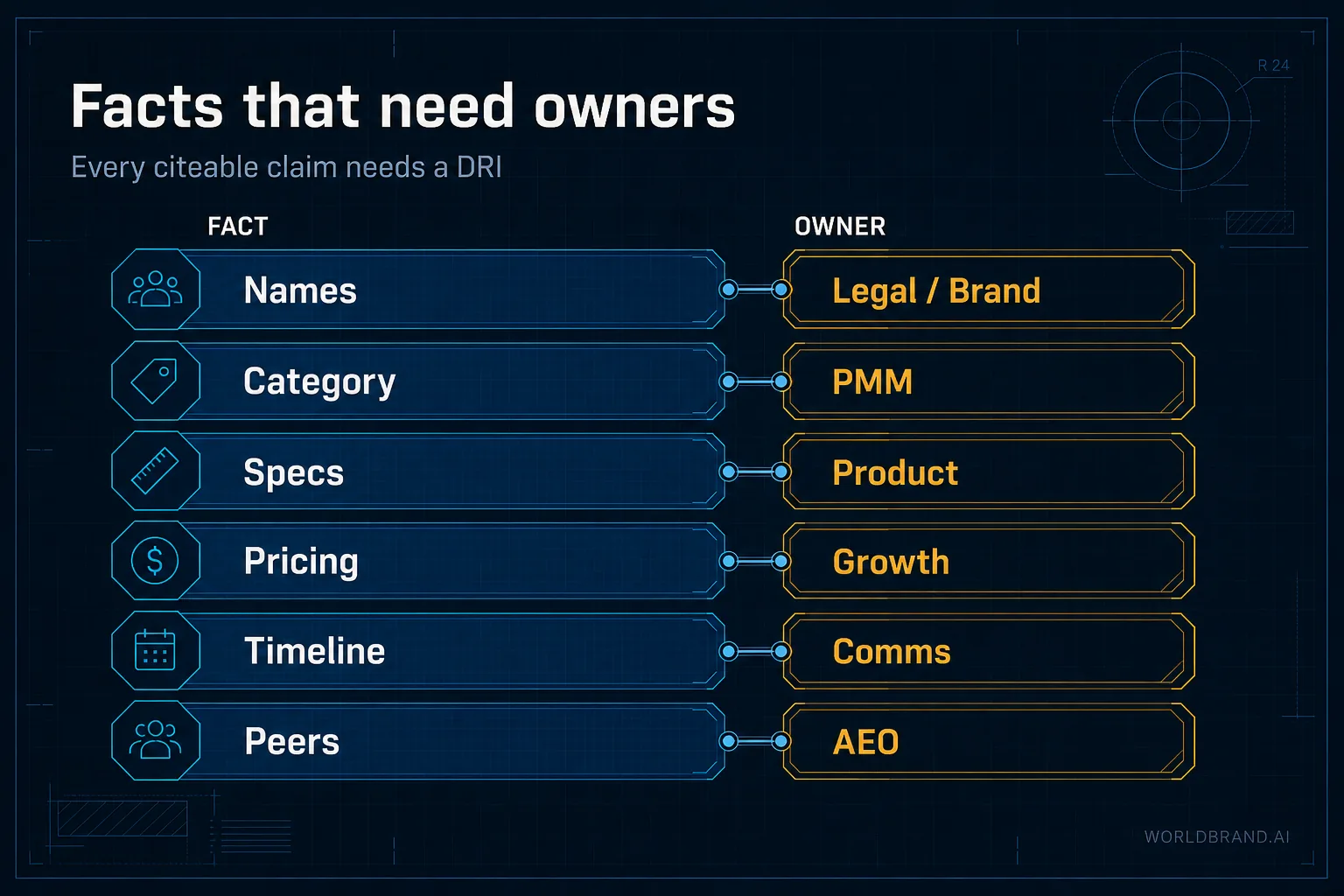
At minimum, assign a directly responsible individual for:
| Fact class | Typical owner | Failure mode if unowned |
|---|---|---|
| Legal + consumer names | Brand / legal | Retrieval miss, wrong entity |
| Category nouns | Product marketing | Category invisibility in AI answers |
| Product scope & specs | Product / PMM | Stale recommendations |
| Pricing language | Growth / web | "Expensive" framing without context |
| Timeline & history | Comms | Encyclopedic conflict |
| Peer set for measurement | AEO lead | Vanity benchmarks |
Brand Wiki and Brand Wiki help you see the spine. They cannot invent accountable humans.
A lightweight RACI that works
| Role | Responsibility |
|---|---|
| Responsible | Updates the source of truth page |
| Accountable | Accepts risk if AI answers are wrong |
| Consulted | Legal, regional leads |
| Informed | AEO, sales enablement, content |
Keep the matrix on one page. If it needs a workshop facilitator every quarter, it is already too heavy.
Review the matrix when you launch a sub-brand, enter a new market, or change category nouns—not only at annual planning.
Connect ownership to AEO tickets
When AEO Intelligence shows a citation to a wrong spec:
- Identify the fact class
- Route to the DRI (not to "marketing generally")
- Set SLA (acknowledge / correct / re-measure)
- Log the URL that misled the model
Without this path, weekly AEO meetings become complaint circles. Pair ownership with an evidence repair backlog so tickets stay concrete.
Suggested SLAs that survive real orgs:
| Stage | Target |
|---|---|
| Acknowledge | Within two business days |
| Correct or decide | Within ten business days for P0/P1 conflicts |
| Re-measure | Affected prompt cluster within two weeks of the fix |
Example conflict ticket
Symptom: Comparison prompts cite a partner microsite with a 2022 product scope.
Fact class: Specs
Source of truth decision: Product docs (note logged)
DRI: PMM
Success: Stale microsite updated or de-indexed from the citation path; conflict rate on that cluster drops on re-measure.
That is ownership in action—not a policy PDF.
Brand Wiki as the escalation surface
Use Brand Wiki when ownership is unclear: open the brand, inspect conflicting modules, and decide which system wins for which fact. Document the decision. Then fix downstream copies.
Write the decision as a one-liner in the ticket: "Category noun = X; source of truth = About page; Brand owns updates." Ambiguity is what models exploit.
Regional and sub-brand complications
Global brands often need nested ownership:
| Layer | Owns |
|---|---|
| Global DRI | Legal name and master category |
| Local DRI | Language-specific nouns and local peers |
| Product-line DRI | Specs that change faster than the parent story |
If local AI answers fail while global equity looks fine, check ownership before you check ad spend—see When Global Brands Fail Local AI Answers.
30-day kickoff
- Draft the one-page matrix with named humans
- Diff five core facts across site, newsroom, and reference surfaces
- Open three P0/P1 tickets with DRIs and re-measure dates
- Put the matrix link in the weekly AEO agenda footer
If step 1 fails, stop buying more measurement tools. You do not have an operating system yet.
FAQ
What if the RACI owner is still "Marketing"?
Departments do not ship corrections—named humans do. If the matrix lists a function instead of a person with calendar authority, treat it as unsigned and redo step one before opening more AEO tickets.
How do we attach fact ownership to the weekly AEO meeting?
Put the matrix link in the agenda footer and refuse to close without tickets that name fact class, DRI, and re-measure date. Screenshots without routing are complaint circles, not governance.
When should we reopen the matrix?
At sub-brand launch, new market entry, or any category-noun change—not only at annual planning. Waiting for a workshop facilitator every quarter means the matrix is already too heavy to run.
What is the anti-pattern that wastes the most AEO budget?
Buying measurement tools before named DRIs exist. You will pay to rediscover the same five conflicting facts until someone owns the source of truth page.
Where WorldBrand.ai fits in fact governance
- AEO Intelligence — visibility, narrative, sources, and competitive presence on locked prompts
- Brand Wiki — structured brand profiles and the public facts models can cite
- World Model — explore how a brand decision could unfold (coming soon)
Bottom line
Brand facts are shared assets with private consequences. If nobody owns them, answer engines will own your narrative instead. Name the DRIs. Publish the matrix. Tie AEO repairs to humans with calendars.