

Brand value and AI visibility are often confused because both sound like "how big we are." They are not the same asset—and that gap is becoming a board-level problem.
Two scoreboards, two physics
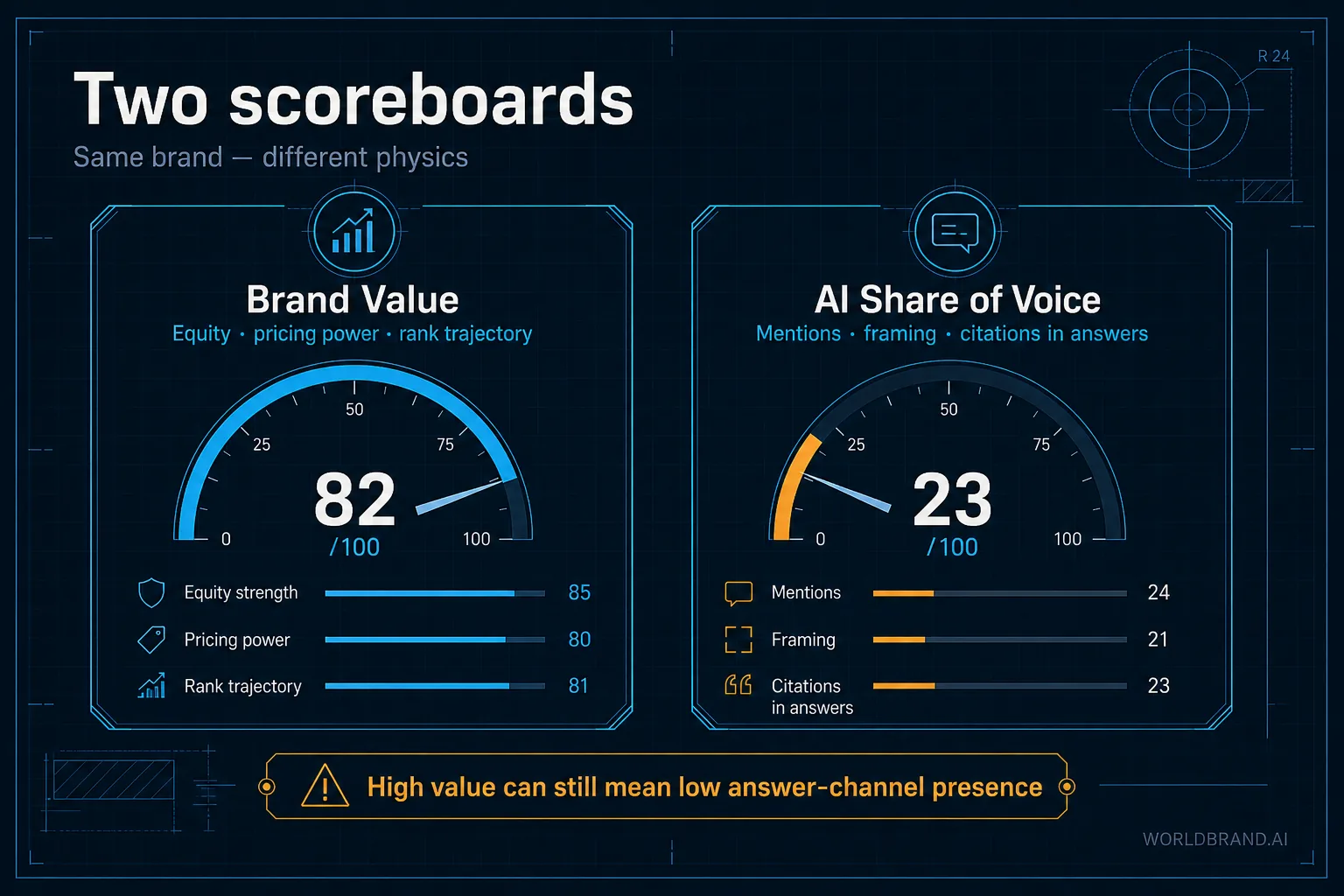
Brand value is a financial and strategic estimate of brand strength in markets. AI share of voice is how often and how favorably answer engines name you when buyers ask category questions. One can be excellent while the other is mediocre.
Brand value compounds through revenue quality, pricing power, awareness, and long-horizon equity. Methodologies differ, but the object is still economic brand.
AI share of voice compounds through something narrower and stranger: whether models can retrieve, corroborate, and briefly narrate you when they must pick a shortlist. It cares about:
- Category language consistency
- Third-party citeability
- Fresh, non-conflicting public facts
- Peer density in training and browseable sources
A beloved heritage brand with thin digital evidence can look rich on a valuation chart and poor inside ChatGPT. A digitally loud challenger can punch above its valuation in AI answers—until the evidence war catches up.
Why leaders lose the answer channel
We see the same patterns across categories:
Equity without encyclopedic clarity. The brand is famous. The public record is messy—wrong founding years, outdated product lines, conflicting category labels. Models hedge or skip.
Offline gravity, online silence. Distribution and retail strength do not automatically create the comparison pages, analyst notes, and documentation clusters assistants lean on.
Peer set mismatch. Valuation peers and AI shortlist peers are different. You benchmark against giants on value, then lose mid-funnel prompts to specialists who fit the question better.
Sentiment tax. You get mentioned as expensive, complicated, or legacy. In a three-name answer, that framing is the ranking.
How to read the divergence
Put the two views side by side—ideally inside Brand Wiki, where valuation context and AI perception can live in one workflow:
- Value position — rank, value trend, industry cohort (brand equity)
- Answer position — mention rate and share of voice on a locked prompt set (AEO Intelligence)
- Narrative quality — sentiment and repeated adjectives
- Evidence quality — which domains get cited when you appear
Interpretation cheat sheet:
| Pattern | Likely story |
|---|---|
| High value, low SOV | Famous but hard to extract / poorly corroborated online |
| High SOV, lower value | Digitally fluent challenger; equity may lag awareness |
| High both | Rare; protect consistency and keep measuring |
| Low both | Category problem or measurement set is wrong |
Strategy when value leads SOV
Do not "rebrand for ChatGPT." Repair the evidence graph:
- Align category nouns across site, PR, and partner pages
- Update specs, pricing language, and product scope where public pages conflict
- Strengthen encyclopedic and reference surfaces (Brand Wiki is built for that reading layer — start with Apple Inc. or Brand Wiki)
- Earn third-party mentions that repeat the same factual spine
- Re-measure on the same prompts for four to six weeks before declaring progress
Creative campaigns still matter. They matter more after models have a clean, repeated story to retrieve.
Strategy when SOV leads value
Enjoy the answer-channel lead—and monetize credibility before competitors copy your evidence playbook. Use Brand Wiki workflows to connect visibility wins to commercial narratives: which segments see you, which peers you displace, which claims stick.
Also watch for brittle SOV: mentions driven by a single viral roundup or a stale affiliate cluster can vanish when models refresh. Pair SOV with preference proxies (recommend language, first-mention, trust framing) so inclusion is not mistaken for preference—see Share of Voice Is Not Preference.
Ownership on a split scoreboard
Assign different DRIs with a shared quarterly bet:
| Owner | Watches |
|---|---|
| Equity owner | Brand value trajectory |
| Answer-channel owner | Locked prompt families and evidence tickets |
| Both (joint) | One leadership decision each quarter: defend, accelerate, or repair |
The board conversation to have
Stop asking only "What is our brand worth?" Ask a paired question: "When an assistant has to name three options in our category, are we one of them—and said how?"
WorldBrand's stack exists for that pairing: Brand Wiki on one side, AEO Intelligence on the other. Brand value remains a core strategic asset. AI share of voice is the new scarcity layer on top of it.
If your equity story and your answer story disagree, believe both—and fund the gap.
FAQ
Who owns each scoreboard when they diverge?
Split DRIs: an equity owner for brand equity trajectory and an answer-channel owner for locked prompts and evidence tickets. They share one quarterly bet on the leadership slide—not one blended owner pretending both numbers are the same problem.
How do we attach both metrics to planning we already run?
Put value rank and AI SOV on the same quarterly review slide with the interpretation cheat sheet, then route gaps to the right backlog—evidence repair when value leads SOV, commercial narrative work when SOV leads value.
What should leadership NOT do when the scoreboards split?
Do not collapse both into one vanity KPI, "rebrand for ChatGPT," or celebrate SOV spikes without checking whether mentions are preference or brittle citation clusters.
What is the board-meeting failure mode to watch for?
Reviewing brand value alone while mid-funnel assistants omit you from shortlists—or treating a digitally loud SOV win as proof of durable equity without monetization and evidence depth.
Where WorldBrand.ai fits
- AEO Intelligence — visibility, narrative, sources, and competitive presence on locked prompts
- Brand Wiki — structured brand profiles and the public facts models can cite
- World Model — explore how a brand decision could unfold (coming soon)
Bottom line
When an assistant has to name three options in your category, are you one of them—and said how? That paired question belongs beside every brand-value readout.