

Global brands assume fame travels. Answer engines often disagree—a brand can dominate home-market AI answers and vanish from another region's shortlists. That is rarely a brand problem alone; it is usually a local evidence and category-language problem.
Why global strength fails locally
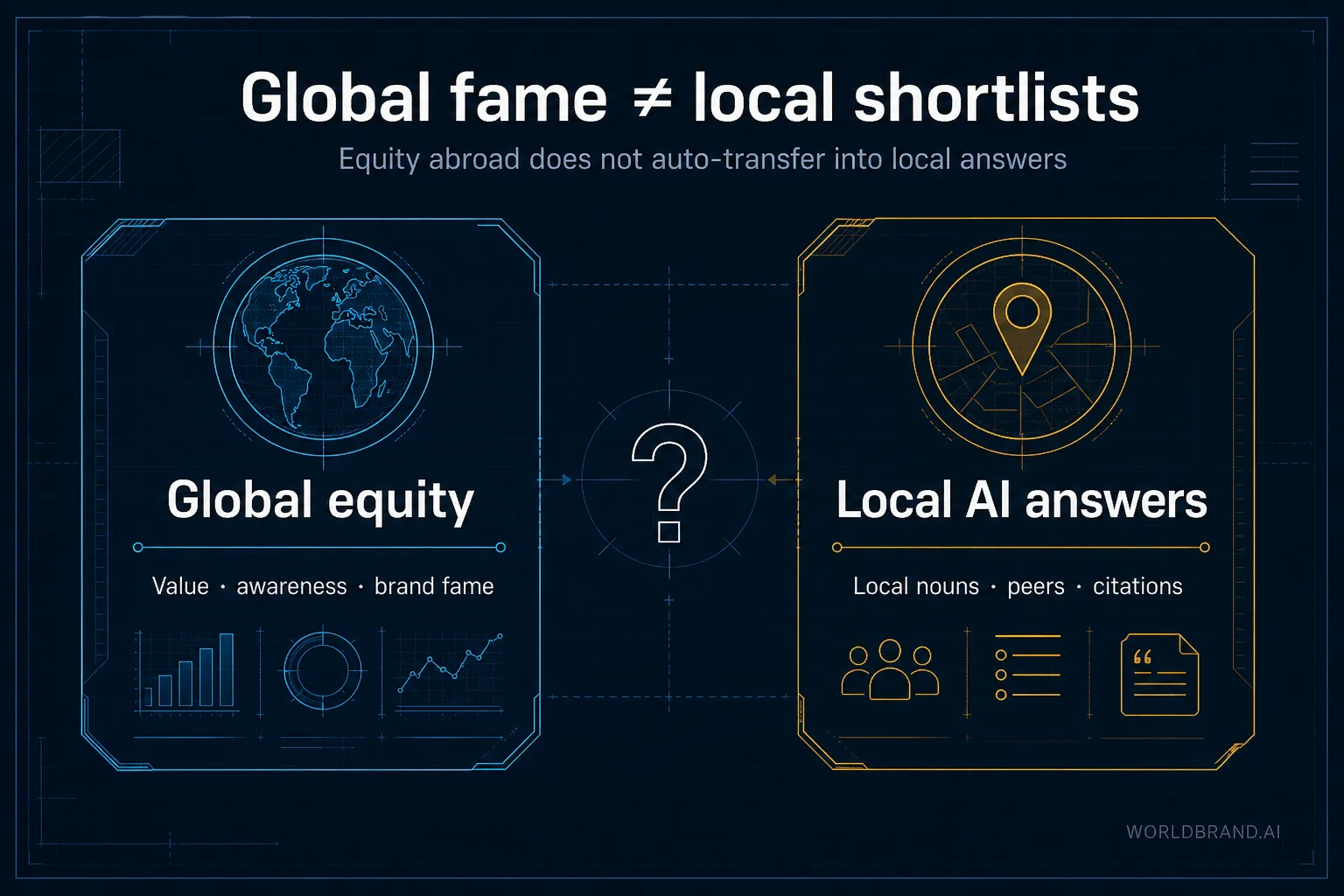
- Category nouns differ by market
- Reference and review ecosystems are local
- Product assortment and pricing pages are geo-specific
- Peers change: global giant vs local specialist
- Models and browse tools weight local sources unevenly
Brand Wiki globalization scores hint at structural reach. They do not replace local AI measurement. A high globalization dimension can coexist with near-zero local SOV if the local evidence graph is thin.
How to diagnose
- Split prompt sets by market in AEO Intelligence—do not rely on English-global only.
- Rebuild peer sets per market (local specialists matter).
- Compare citation domains by region.
- Inspect Brand Wiki for geo-specific fact conflicts (Brand Wiki).
- Read Brand Wiki industry and relationship context as context, not as a substitute for local SOV.
Run the diagnosis on the same calendar as your global review so local gaps cannot be dismissed as "next quarter's problem."
Common patterns
| Pattern | Likely cause |
|---|---|
| Strong global SOV, weak local | Local category language / sources thin |
| Local mentions, hostile framing | Local reviews / pricing pages |
| Present only on branded local prompts | Discovery failure |
| Engine split by region | Source mix differs; repair locally |
What to fund
- Localize citeable pages—not just slogans
- Align assortment facts with what local pages claim
- Earn local corroboration (credible regional publishers)
- Keep measurement localized for two cycles before declaring "global brand health"
- Assign local fact DRIs where nouns and peers diverge from the global matrix
Example readout
| Posture | What leadership hears |
|---|---|
| Bad | "We're a global brand, so AI visibility is fine." |
| Better | "English category SOV is 22% vs peer set; Japanese mid-market category SOV is 6%, with citations concentrated in two local review domains that still list a deprecated SKU. Local PMM owns the assortment page repair; re-measure in two weeks." |
Anti-patterns
- Translating homepage hero copy and calling it localization
- Using the global peer set in a market where buyers shortlist different specialists
- Declaring victory from branded local prompts ("Is [Brand] good?") while category prompts stay empty
- Centralizing all tickets in HQ with no local DRI for nouns and assortment
Ownership that travels
Global equity owners and local answer-channel owners need a shared ticket board. Without it, HQ celebrates brand equity while local teams lose shortlists they never measured. Pair this with Who Owns Brand Facts Across the Organization?.
| Scope | Owns |
|---|---|
| Global | Legal name, master category, franchise claims |
| Local | Language nouns, local peers, assortment pages, regional citations |
| AEO lead | Local prompt-set version ID and re-measure calendar |
Quarterly checklist
- Local prompt-set version frozen?
- Local peer set reviewed?
- Top citation domains by market listed?
- One local P0/P1 evidence ticket closed this quarter?
- Brand Wiki profile shows no geo-specific fact conflicts on the five core claims?
If you cannot check those boxes, you do not have a global AI visibility program—you have an English snapshot with optimism.
FAQ
Who should own local vs global fact repair?
Global DRIs own legal name, master category, and franchise claims; local DRIs own language nouns, assortment pages, and regional citations. If every ticket routes to HQ, local shortlist gaps will keep reopening after the global slide deck ships.
How do we attach local measurement to reviews we already run?
Freeze local prompt-set versions on the same calendar as global brand equity or leadership readouts—do not let English-only snapshots close the meeting while regional gaps stay unmeasured.
What is the fastest way to kill a local program?
Translate the homepage hero, reuse the global peer set, and declare victory on branded prompts while category prompts stay empty. That produces activity metrics, not local shortlist repair.
When should we stop calling it "global brand health"?
After two localized measurement cycles with market-specific peers and citation domains—not after one English-global snapshot with optimistic framing.
Where WorldBrand.ai fits in local diagnosis
- AEO Intelligence — visibility, narrative, sources, and competitive presence on locked prompts
- Brand Wiki — structured brand profiles and the public facts models can cite
- World Model — explore how a brand decision could unfold (coming soon)
Bottom line
Globalization in brand strategy and localization in AI answers are sibling disciplines. Use Brand Wiki for local facts and AEO Intelligence for local shortlists.
Global fame without local evidence is a story models will not reliably tell.