

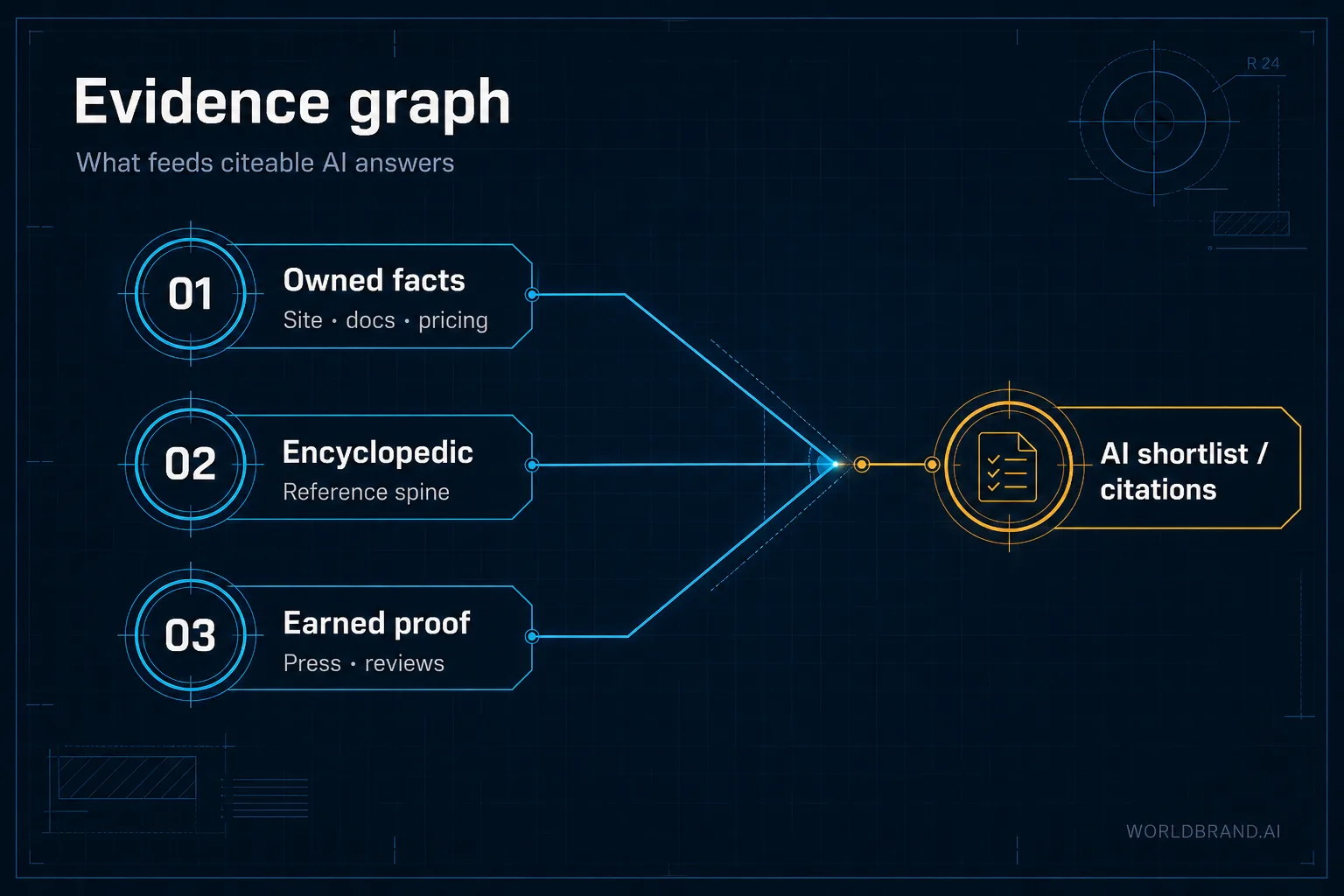
Marketers love to declare Wikipedia "old media." Answer engines disagree—when models need a compact, checkable story, they still lean on encyclopedic and reference-like sources more than brand teams expect.
If your public reference layer is thin, conflicted, or outdated, your AEO program is running uphill.
What "encyclopedic" actually means here
We are not telling you to spam Wikipedia. We are saying brands need a stable factual spine that third parties can repeat:
- Who you are (legal / consumer names aligned)
- What category you compete in (buyer nouns, not internal codenames)
- What is current vs historical
- What is disputed vs settled
- Where authoritative detail lives next
Brand Wiki is WorldBrand.ai's encyclopedia-style reading layer: identity, category, and citeable profile facts in one place.
Concrete citeable profiles (HTML + JSON):
- Apple Inc. on Brand Wiki · machine JSON
- Nongfu Spring on Brand Wiki
- Beverages category hub
- AI discovery index: /brand-wiki/llms.txt
Do not invent ranking scores on Brand Wiki. Use the profile for identity, claim status, and citeable facts — treat missing fields as unavailable.
Why models care about reference hygiene
Models optimize for plausible completeness under uncertainty. Encyclopedic sources help because they are:
| Property | Why models lean on it |
|---|---|
| Structured | Sections map cleanly to questions |
| Corroborated | Claims are expected to be sourced |
| Comparative | Categories and peers appear in context |
| Sticky | Once wrong, they stay wrong until someone maintains them |
A glowing homepage cannot replace that function. A campaign film cannot replace that function. A gated PDF especially cannot.
Owned pages still matter—they are often the fastest place to fix a fact. They are not enough when engines want independent corroboration before they treat a claim as safe to repeat.
Failure modes we see repeatedly
| Mode | What happens |
|---|---|
| Absence | No serious reference footprint in the languages that matter; category prompts skip you |
| Conflict | Site says 2019 launch; reference page says 2014; review sites invent a third story—models hedge or pick the loudest wrong version |
| Category misfile | Filed under a dead product line or parent conglomerate narrative that no longer matches how buyers search |
| Stale triumphs | Page still centers a deprecated product; assistants confidently recommend a ghost |
| Orphan growth brands | Sub-brands have commercial heat but no clean identity graph—logo, name, parentage, category |
| Local thinness | Global English coverage looks fine while local-language category answers never see you |
AEO without reference work is cosplay
You can buy tools, run prompts, and screenshot absences forever. If the underlying public record cannot support a 120-word accurate answer, engines will prefer a peer whose record can.
That is why citation strategy and encyclopedic hygiene are the same program wearing two hats:
- Measure who gets named (AEO Intelligence)
- Inspect whether your factual spine can survive extraction (Brand Wiki)
- Repair conflicts at the source—not in the prompt set
If your weekly AEO meeting only debates screenshots, you are optimizing the symptom. Put the factual spine on the agenda next to share of voice.
A practical maintenance loop
Inventory the five facts most often needed in category answers (category label, flagship offer, geography, differentiator, proof point).
Diff those facts across homepage, docs, newsrooms, and encyclopedia-class pages.
Normalize names and category nouns.
Date claims that go stale (pricing, product scope, leadership).
Corborate with at least one independent, citeable source for each high-stakes claim.
Re-measure on the same unbranded prompts two weeks later.
Treat this as a standing workstream with a DRI—closer to brand governance than to a one-off PR favor. Notability rules on Wikipedia still apply; the operating point is reference-grade evidence, whether or not a Wikipedia page exists today.
What "good enough" looks like for leadership
A healthy reference posture is not a perfect encyclopedia entry. It is:
- One consistent category noun buyers actually use
- No unresolved date or product conflicts across top citeable URLs
- Clear parent / sub-brand relationships where they matter
- A known owner for the next stale claim
Report that as a checklist in the quarterly note—beside AEO Intelligence presence—not as a Wikipedia vanity metric.
FAQ
Who should own encyclopedic hygiene if comms "doesn't do Wikipedia"?
Assign a DRI with calendar authority for the factual spine—not a department label. Reference maintenance is brand governance; treating it as someone else's 2015 PR favor is how stale triumphs stay in category answers.
How do we attach reference work to the weekly AEO rhythm?
Put the five-fact inventory and diff on the agenda beside share of voice—not after screenshot debate. If the meeting ends without a stale-claim owner, you optimized the symptom again.
What should we not do when Wikipedia is thin or contested?
Do not spam edits, buy vanity coverage, or declare victory from owned pages alone. Improve citeable third-party corroboration, normalize owned facts, and re-measure on the same unbranded prompts two weeks after each repair.
When is reference work "good enough" to stop?
When leadership can report one consistent category noun, zero unresolved conflicts across top citeable URLs, clear parent/sub-brand relationships, and a named owner for the next stale claim—not when a perfect encyclopedia entry exists.
Where WorldBrand.ai fits in reference hygiene
- AEO Intelligence — visibility, narrative, sources, and competitive presence on locked prompts
- Brand Wiki — structured brand profiles and the public facts models can cite
- World Model — explore how a brand decision could unfold (coming soon)
The cultural point
Treating Wikipedia-class coverage as someone else's problem is a 2015 attitude. In the citation economy, reference hygiene is brand infrastructure—closer to legal naming consistency than to optional PR garnish.
WorldBrand.ai will not edit Wikipedia for you. It will help you see when your brand story is not extractable—and connect that diagnosis to visibility, value, and strategic scoring.
In AI answers, what cannot be cleanly known often cannot be cleanly chosen.