
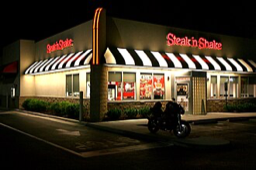
Steak 'N Shake
American restaurant chain known for Steakburgers and hand-dipped milkshakes.
Last updated August 31, 2026
AI crawler reads
No AI crawler has read this profile since Oct 28, 2026.
Overview
Steak 'n Shake is an American restaurant chain whose identity is built around burgers marketed as Steakburgers, hand-dipped milkshakes, fries and classic counter-service dining. A. H. “Gus” Belt founded the business in Normal, Illinois, in February 1934 by converting his combination gas station and chicken restaurant into a hamburger stand. The name’s “steak” refers to the beef used in the signature burger rather than to a steakhouse format. Belt promoted the preparation publicly, bringing barrels of T-bone, sirloin and round steaks into view and grinding the meat in front of customers. The practice supported the slogan “In Sight, It Must Be Right,” which addressed contemporary concerns about the quality and composition of ground beef. The early chain expanded through the conversion of Goal Post restaurants in central Illinois and the addition of curb service. After Belt’s death in 1954, the business passed through several ownership periods. His wife, Edith, operated the chain until 1969; Longchamps owned it briefly from 1969 to 1971; and Indianapolis-based Franklin Corporation subsequently acquired it and moved the headquarters from Normal to Indianapolis. E. W. Kelley and Associates purchased Steak 'n Shake and Franklin in 1981, and E. W. Kelley led the restaurant company until his death in 2003. Entrepreneur Sardar Biglari gained control in 2008 after a period of declining comparable-store sales and operating losses. His turnaround program narrowed the menu, concentrated attention on burgers, fries and shakes, and pursued sharper value pricing. The effort initially produced a sustained improvement in comparable-store sales and profitability. From the middle of the 2010s, however, the chain faced renewed pressure from restaurant competition, underinvestment in its locations, labor and service-cost challenges, litigation involving employment classification, and debt burdens. Biglari Holdings later sought to restructure the business around franchising rather than owning and operating most restaurants directly. In 2018, Steak 'n Shake introduced a franchise-partner model under which individual operators could assume responsibility for existing restaurants with a comparatively low initial entry payment in exchange for sharing restaurant profits with the company. The strategy aimed to reduce corporate capital requirements and convert company-operated units to franchised operations. The COVID-19 pandemic intensified the chain’s financial and operating difficulties, while the number of locations declined from the late-2010s level. By the end of 2024, the system had 426 company-operated and franchised locations in 26 states and the District of Columbia, according to the cited reference material. The operating model has also changed. Beginning in 2021, the company moved away from traditional full-service dining, replacing many lunch counters and staffed ordering processes with self-service kiosks and emphasizing drive-through and pickup. The stated objective was to shorten service times, reduce labor requirements and make the restaurants more consistent with a fast-food format. Steak 'n Shake remains primarily concentrated in the Midwestern United States, with additional locations elsewhere in the country and a limited international presence. Recent brand activity has included a shift toward beef tallow for fries, Wisconsin butter in place of a buttery blend, and Bitcoin payments at U.S. restaurants.
History
Steak 'n Shake began in February 1934 when Gus Belt converted his Normal, Illinois, gas station and chicken restaurant into a hamburger stand. Belt’s visible grinding of steak cuts into burger meat became an early quality-marketing device and helped establish the Steakburger concept. The business expanded across central Illinois, including through the conversion of Goal Post restaurants, and added curbside service alongside indoor dining. After Belt died in 1954, the chain continued expanding and passed through several owners. Edith Belt ran the business until 1969. Longchamps, an East Coast steakhouse company, then owned it for a short period before Indianapolis-based Franklin Corporation acquired the chain and relocated its headquarters to Indianapolis. In 1981, E. W. Kelley and Associates acquired Franklin and Steak 'n Shake. E. W. Kelley remained the leading figure in the company until his death in 2003. The company’s later history has been shaped by changes in ownership, format and financial strategy. Sardar Biglari took control in August 2008 after a period of falling same-store sales and substantial daily losses. The recovery plan simplified the menu, emphasized burgers, fries and milkshakes, and used aggressive pricing. The approach initially generated a long run of comparable-sales increases and restored profitability, but later price pressure, limited restaurant investment, competition from fast-casual concepts, employment litigation and debt created new difficulties. In 2018, the company tried to move toward a predominantly franchised system. Its franchise-partner program offered operators control of existing restaurants for a low initial payment while requiring substantial profit sharing. The plan was intended to transfer operating responsibility and capital needs away from the corporate parent. The pandemic-era closure of restaurants compounded the company’s financial stress. Steak 'n Shake subsequently moved away from its traditional casual-dining format. From 2021, restaurants increasingly adopted self-service kiosks, drive-through service and customer pickup. Management presented the change as a response to slow preparation times and the cost of employing table-service staff. The brand’s footprint contracted as it retreated from several states entered during its early-21st-century expansion. At the end of 2024, the system comprised 426 company-operated and franchised locations in 26 states and Washington, D.C., based on the cited reference material. International expansion was attempted in the United Arab Emirates and Europe. The company opened a corporate office in Monte Carlo in 2013 to support West Asian and European development, but the planned UAE rollout did not reach its announced scale and the UAE restaurants later closed. The brand’s continuing base remains the United States, particularly the Midwest. Recent initiatives have emphasized ingredient changes associated with traditional fats and butter, as well as cryptocurrency payment acceptance.
- 2025
Ingredient and payment initiatives announced
[1]The brand announces beef-tallow fries, a Wisconsin-butter change and Bitcoin payments at U.S. locations.
- 2021
Kiosk and fast-food transition accelerates
[1]Self-service kiosks and drive-through service become central to the new operating model.
- 2018
Franchise-partner strategy launches
[1]The chain begins a major effort to convert corporate restaurants into franchised operations.
- 2013
International development office opens
[1]Steak 'n Shake establishes a corporate office in Monte Carlo to support planned European and West Asian expansion.
- 2008
Sardar Biglari takes control
[1]Biglari assumes control and launches a turnaround centered on a smaller menu and the core burger-and-shake proposition.
- 1981
E. W. Kelley and Associates acquires the chain
[1]The Indianapolis-based restaurant business changes ownership under E. W. Kelley and Associates.
- 1969
Longchamps ownership period begins
[1]After Edith Belt’s operating period, Longchamps acquires the chain for a short ownership term.
- 1954
Expansion into Indiana begins
[1]The first Indiana restaurant opens in Indianapolis as a drive-in with curb service, table service and takeout.
- 1934
Steak 'n Shake is founded
[1]Gus Belt converts his Normal, Illinois, gas station and chicken restaurant into the first Steak 'n Shake hamburger operation.
Products and positioning
Classic, value-oriented American burger dining transitioning from casual table service toward fast-food, drive-through and kiosk service.
Burger · 1934
Steakburger
The signature burger line and the source of the “steak” in the brand name. Historically, the company emphasized steak cuts and visible preparation to distinguish its burgers from ordinary ground-beef offerings. Steakburgers remain the central food platform around which the chain organizes its menu and marketing.
Beverage and dessert · 1934
Hand-dipped milkshakes
Thick milkshakes prepared from ice cream and flavor ingredients are one of the chain’s most recognizable offerings. They are sold in multiple flavors and are commonly paired with Steakburgers and fries.
Side dish · 1934
French fries
Fries are a core side item. In 2025, Steak 'n Shake announced a move to cooking them in 100% beef tallow, presenting the change as part of a broader ingredient-positioning initiative.
Other menu items · 1934
Sandwiches, salads and desserts
Beyond burgers and shakes, the menu has included chicken and other sandwiches, salads, desserts, soft drinks and related sides. The precise range varies by restaurant and operating period.
Controversies
2017
Maryland franchise financial and criminal case
A Maryland franchise location entered financial distress, with court action involving unpaid loans and taxes. The franchise owner was later indicted in a case alleging a plot to kill his wife and burn the restaurant to obtain insurance proceeds. The allegations concerned the franchise operator, not a finding that the corporate brand committed the alleged acts.
2010
Manager overtime and classification litigation
Former managers sued over alleged misclassification as salaried employees and alleged denial of earned overtime. The litigation was cited as one of the pressures affecting the chain during its later difficulties.
Marketing campaigns
- 2025Make America Healthy Again ingredient positioning
United States
The brand promoted beef-tallow fries and a switch from a seed-oil-containing buttery blend to Wisconsin butter. The positioning was publicly linked by supporters to a broader American food-policy debate.
Outcome. Generated political praise and criticism from health professionals and scientists.
- 1934In Sight, It Must Be Right
United States
An early quality message built around grinding steak cuts in front of customers. The visible preparation reassured diners about the source and quality of the burger meat.
Outcome. Helped establish the Steakburger proposition and the chain’s transparent-preparation identity.
Brand decisions
2025
Introduce beef-tallow friesProduct launchBackground
The company sought to emphasize a different cooking fat amid public debate about seed oils and food ingredients.
Action taken
It announced that fries would use 100% beef tallow from March 1.
Aftermath
The announcement received political praise and criticism from health experts.
2025
Accept Bitcoin paymentsOtherBackground
The chain pursued a new payment option for its U.S. restaurant system.
Action taken
Beginning May 16, Steak 'n Shake accepted Bitcoin through the Lightning Network at U.S. locations.
Aftermath
The company said international units could be added later.
2021
Move from casual dining to fast foodStrategyBackground
The traditional model required dining-room staff and could involve long preparation and service times.
Action taken
Restaurants increasingly adopted self-service kiosks, drive-through service and customer pickup.
Aftermath
The format reduced reliance on staffed ordering and table service and became a central part of the company’s operating strategy.
2018
Adopt a franchise-partner modelStrategyBackground
The company faced capital requirements, debt and underperforming company-operated restaurants.
Action taken
Steak 'n Shake offered existing restaurants to entrepreneurial operators for a low initial payment with substantial profit sharing.
Aftermath
The company pursued a broader shift toward franchising, but the location base subsequently contracted and the pandemic added pressure.
2008
Simplify the menu and refocus on core productsStrategyBackground
The chain was experiencing declining comparable-store sales and operating losses.
Action taken
Management reduced the menu substantially and concentrated the proposition on burgers, fries and milkshakes while using value pricing.
Aftermath
The turnaround was followed by a prolonged period of improved comparable-store sales and profitability, although later performance deteriorated.
Recent events
- Unconfirmed
Steak 'n Shake permanently closes 57 restaurants[3]
Reported:
Steak 'n Shake permanently closed 57 restaurants during the first quarter of 2020, including 51 company-owned locations and six franchised locations.
Sources8 sources
- 1Steak 'n Shakeen.wikipedia.org
- 2Steak 'n Shake official websitesteaknshake.com
- 3Steak 'n Shake 永久关闭57家餐厅abc15.com
- 4Steak 'n Shake permanently closes 57 of its restaurants amid coronavirus crisisfox4news.com
- 5Steak 'n Shake permanently closes 57 restaurants amid coronavirus pandemictoday.com
- 6Steak 'n Shake permanently closes 57 restaurants amid coronavirus pandemicyahoo.com
- 7Steak 'n Shake permanently closes nearly 10 percent of its restaurants amid coronavirus crisisfoxnews.com
- 8Thread: Steak 'n Shake permanently closes 57 restaurants as company suffers during pandemicalipac.us
Cite this profile: Cite the canonical profile. /brand-wiki/steak-n-shake · Editorial policy · How profiles are compiled