
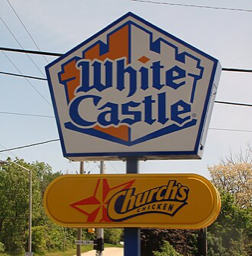
White Castle
White Castle is a privately held American hamburger restaurant chain known for its small square hamburgers, called sliders, and castle-inspired restaurants.
Last updated August 25, 2026
AI crawler reads
No AI crawler has read this profile since Oct 28, 2026.
Overview
White Castle is an American hamburger restaurant chain founded in Wichita, Kansas, in 1921 by short-order cook Walter A. Anderson and businessman Edgar Waldo "Billy" A. Ingram. It is generally credited as the world's first fast-food hamburger chain and remains one of the oldest continuously operating restaurant brands in the United States. The company built its identity around small, square hamburgers—widely known as sliders—prepared in high volumes and sold at accessible prices. The brand emerged at a time when many Americans were suspicious of ground beef because of concerns about meat-processing sanitation. Anderson and Ingram responded by making cleanliness and standardization central to the concept. Early restaurants used white enamel, stainless steel, and porcelain-steel construction, while employees wore clean uniforms and paper hats. The distinctive white buildings, often topped or detailed with castle-like architectural features, made the restaurants recognizable and helped communicate order and hygiene. White Castle expanded through company-owned restaurants rather than franchising. The founders developed centralized production, distribution, bakeries, meat facilities, warehouses, and building operations to maintain consistency across locations. Ingram also created related businesses, including Paperlynen, which produced paper hats and other paper products, and Porcelain Steel Buildings, which manufactured prefabricated restaurant structures. The company incorporated in 1924 as White Castle System of Eating Houses Corporation. Anderson sold his interest to Ingram in 1933, after which the Ingram family retained control. The chain expanded through the Midwest during the 1920s and later established a substantial presence in the New York metropolitan area. Its geography has remained comparatively concentrated because the company has declined to franchise, take on public equity, or pursue aggressive debt-funded expansion. White Castle has nevertheless tested markets outside its traditional footprint, including Florida, Nevada, Arizona, Texas, and several overseas markets. Most international franchise experiments were short-lived, and the brand's restaurant operations have primarily remained in the continental United States. In addition to restaurants, White Castle sells frozen versions of its sliders through supermarkets nationwide, with availability varying by retailer. Its restaurant menu has broadened beyond the original beef slider to include chicken products, breakfast items, plant-based offerings, fries, and other limited or regional products. The company introduced a dairy-free-bun Veggie Slider in 2015 and began selling Impossible plant-based sliders in 2018. White Castle is still controlled by the Ingram family and operates as a private company. Lisa Ingram became chief executive in 2016, succeeding E. W. "Bill" Ingram III, who remained chairman. The chain had approximately 345 restaurants in 13 states according to the cited reference material, with its strongest presence in the Midwest and the New York–New Jersey metropolitan area. Its long-standing format, distinctive architecture, low-ticket menu, and cultural association with sliders have made White Castle an influential American fast-food brand.
History
White Castle began in Wichita, Kansas, where Walter A. Anderson operated food stands and diners beginning in the 1910s. In 1921, Anderson partnered with Edgar Waldo "Billy" A. Ingram, an insurance and real-estate businessman, to create a standardized hamburger restaurant system. Their initial investment was reported as $700. The business was incorporated in 1924 as White Castle System of Eating Houses Corporation. The founders designed the concept around speed, low prices, consistency, and public confidence in ground beef. The restaurants were deliberately small and visually controlled, with white enamel or porcelain-steel exteriors, stainless or enameled interiors, and employees in clean uniforms. The castle motif became an important part of the brand's visual identity. White Castle's square hamburgers were inexpensive and easy to produce in volume; the company's slider format later became a defining part of American fast-food vocabulary. The first major expansion occurred in the Midwest, beginning with El Dorado, Kansas, in 1922. During the 1920s and 1930s the company developed centralized supply and manufacturing capabilities instead of relying on a modern franchise network. Paperlynen, established in 1932, produced paper hats and other supplies. Porcelain Steel Buildings, established in 1934, manufactured movable prefabricated restaurant structures using porcelain-enamel panels. Ingram moved the corporate office to Columbus, Ohio, in 1934, placing it nearer the center of the company's distribution system. That year followed Anderson's sale of his interest to Ingram, leaving the Ingram family in control. White Castle's success generated many imitators. Competitors copied the company's white architecture, castle imagery, low-cost hamburger format, and name structure. The company continued publishing an internal employee magazine, first called The Hot Hamburger and later associated with the White Castle Official House Organ and The Slider Times, helping communicate operating practices and company culture across its geographically dispersed system. Expansion was cautious. A Florida experiment begun in 1959 ended when the company closed its Florida restaurants in the late 1960s because distribution was inefficient. Later attempts in Philadelphia, Kansas City, Cleveland-Akron, and other markets also ended, although the company revisited some areas after long absences. International franchise experiments in Japan, Malaysia, Singapore, Mexico, South Korea, and China did not establish a durable worldwide restaurant network. The company has generally relied on company-owned restaurants and has avoided the broad franchising model used by many larger competitors. In the twenty-first century, White Castle added new geographic markets and updated its menu. It opened its first western U.S. restaurant in Las Vegas in 2015, expanded into Arizona in 2019, and returned to Florida with an Orlando restaurant in 2021. The company also introduced vegetarian and plant-based products, including the Impossible Slider. Frozen sliders sold through grocery retailers extended the brand beyond its restaurant footprint. White Castle has experimented with restaurant technology as well. In 2020 it tested Flippy, an automated cooking system, and later expanded use of Flippy 2. These initiatives reflected the chain's long-standing interest in controlled production and operational standardization. The business remains privately held, family controlled, and geographically concentrated, with roughly 345 restaurants in 13 states according to the cited reference material. Its historical significance rests less on scale than on its early role in establishing the standardized hamburger chain and its enduring ownership of the slider format.
- 2025
Texas expansion announced
[1]White Castle announces plans for its first Texas restaurant in The Colony, scheduled for 2026.
- 2021
Orlando restaurant opens
[1]White Castle returns to Florida with a large restaurant in Orlando during its centennial year.
- 2018
Impossible Slider launches
[1]The chain adds a plant-based burger developed to resemble its conventional beef slider.
- 2015
First Las Vegas restaurant opens
[1]White Castle enters the far western United States with a restaurant at the Casino Royale in Las Vegas.
- 1936
Headquarters moves to Columbus
[1]Corporate headquarters relocate from Wichita to Columbus, Ohio.
- 1934
Porcelain Steel Buildings is created
[1]The company establishes a subsidiary producing prefabricated porcelain-steel restaurant structures.
- 1933
Anderson sells his interest
[1]Walter Anderson sells his half of the business to Billy Ingram.
- 1932
Paperlynen is established
[1]White Castle creates a subsidiary to manufacture paper hats and other paper products.
- 1924
Business is incorporated
[1]The company is incorporated as White Castle System of Eating Houses Corporation.
- 1922
Midwestern expansion begins
[1]The chain expands beyond Wichita with a location in El Dorado, Kansas.
Products and positioning
A heritage American fast-food brand centered on affordable, highly standardized square hamburgers, compact restaurants, recognizable castle-inspired architecture, and an intentionally distinctive slider culture.
Hamburger · 1921
Original Slider
White Castle's signature small, square hamburger is steam-grilled and designed for quick, standardized production. It is the product most closely associated with the brand and the source of the widely used term "slider" for a small hamburger.
Hamburger
Cheese Slider
A cheeseburger version of the signature slider, combining White Castle's compact square patty format with cheese and the chain's standard bun and toppings.
Plant-based food · 2015
Veggie Slider
A vegetarian slider introduced with a dairy-free bun in 2015 to provide a meat-free and vegan-compatible menu option, subject to preparation and ingredient conditions.
Plant-based food · 2018
Impossible Slider
A plant-based slider introduced in 2018 using Impossible Foods' meat alternative, positioned as a closer sensory substitute for the chain's beef slider.
Grocery retail
Frozen White Castle sliders
Packaged frozen versions of White Castle-style sliders sold through supermarkets. Grocery distribution extends the brand beyond its restaurant locations, with retail availability differing by market and retailer.
Chicken
Chicken products
The restaurant menu includes chicken-based products, including chicken sandwiches and chicken rings, alongside the core slider range.
Controversies
2019
White Castle recalls frozen hamburger products over possible Listeria contamination
White Castle voluntarily recalled frozen hamburger products after a sample from one of its manufacturing facilities showed the possible presence of Listeria monocytogenes. The company said affected products were being removed from store shelves and urged consumers not to eat them and to throw them away.
Brand decisions
2020
Test Flippy cooking automationOtherBackground
White Castle explored automation for repetitive kitchen tasks and production consistency.
Action taken
The company began testing an automated cooking robot called Flippy in selected Chicago-area restaurants.
Aftermath
The chain later expanded the initiative with Flippy 2, which could handle several food categories and operate with limited human intervention.
2018
Add the Impossible SliderProduct launchBackground
Plant-based meat alternatives were becoming more visible in the U.S. restaurant market.
Action taken
White Castle began offering an Impossible-based slider designed to mimic the taste and texture of beef.
Aftermath
The product gave the heritage chain a high-profile plant-based offering while preserving its familiar slider format.
2015
Launch the Veggie SliderProduct launchBackground
The company sought to offer a meat-free choice and accommodate customers looking for dairy-free ingredients.
Action taken
White Castle introduced the Veggie Slider with a dairy-free bun.
Aftermath
The launch broadened the menu beyond beef and established a platform for later plant-based product development.
1934
Develop prefabricated porcelain-steel restaurantsStrategyBackground
Standardized restaurant construction supported the chain's emphasis on consistent appearance, sanitation, and operating design.
Action taken
White Castle created Porcelain Steel Buildings to manufacture movable steel-frame structures with porcelain-enamel panels.
Aftermath
The approach helped establish the recognizable white, castle-inspired restaurant architecture used by the brand.
1932
Create Paperlynen supply subsidiaryStrategyBackground
White Castle needed reliable access to paper hats and other operating supplies as its restaurant system expanded.
Action taken
The company established Paperlynen to manufacture paper products for its own restaurants and outside customers.
Aftermath
The subsidiary became part of White Castle's vertically integrated operating model and reportedly produced large volumes of paper hats and products.
Recent events
White Castle announces Love Cube meal and strawberry swirl cheesecake[4]
Reported:
White Castle announced a new Love Cube meal for two and a strawberry swirl cheesecake dessert-on-a-stick, both planned to be available on Valentine's Day, February 14, while supplies last.
White Castle partners with Doodle Labs on NFT collection[5]
Reported:
White Castle partnered with Doodle Labs to release a generative-art NFT collection celebrating White Castle's 100th birthday. The collection was scheduled to launch in December 2021.
WWE, White Castle and Grubhub team up on themed meals[6]
Reported:
WWE teamed up with White Castle and Grubhub to offer special WWE-themed meals for delivery.
White Castle plans Flippy robot rollout at about 10 locations[7]
Reported:
White Castle is expanding its partnership with Miso Robotics, with about 10 new White Castle locations set to roll out Miso Robotics' robotic fry cook. The companies said the move would accelerate adoption of the redesigned Flippy robot in kitchens.
White Castle launches Craver Nation loyalty program[8]
Reported:
White Castle launched its first systemwide loyalty program, Craver Nation, accessible through the White Castle app and offering personalized discounts and special offers based on customers' purchase history.
White Castle recalls frozen hamburger products over possible Listeria contamination[3]
Reported:
White Castle voluntarily recalled frozen hamburger products after a sample from one of its manufacturing facilities showed the possible presence of Listeria monocytogenes. The company said affected products were being removed from store shelves and urged consumers not to eat them and to throw them away.
Sources10 sources
- 1White Castle (restaurant)en.wikipedia.org
- 2White Castle official websitewhitecastle.com
- 3White Castle recalls frozen hamburger products over possible Listeria contaminationfoxbusiness.com
- 4White Castle宣布推出Love Cube套餐和草莓旋纹芝士蛋糕prnewswire.com
- 5White Castle与Doodle Labs合作推出NFT系列prnewswire.com
- 6WWE、White Castle与Grubhub合作推出主题餐点411mania.com
- 7White Castle计划在约10家门店部署Flippy机器人techcrunch.com
- 8White Castle推出Craver Nation忠诚度计划prnewswire.com
- 9White Castle Issued A Recall On Their Frozen Products! | 104.3 MYFM | Valentine In The Morning1043myfm.iheart.com
- 10WWE Partners With White Castle For Themed Meals, $5 Promo Code Insidewrestlingnewssource.com
Cite this profile: Cite the canonical profile. /brand-wiki/white-castle · Editorial policy · How profiles are compiled