
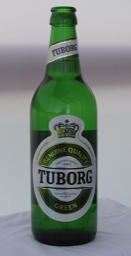
Tuborg
Tuborg is a Danish beer brand founded in 1873 and owned by the Carlsberg Group.
Last updated October 6, 2026
AI crawler reads
No AI crawler has read this profile since Oct 28, 2026.
Overview
Tuborg is a Danish beer brand with roots in the establishment of Tuborgs Fabrikker in the port district of Hellerup, north of Copenhagen, in 1873. The venture was associated with industrialist Carl Frederik Tietgen and a group of investors seeking to develop a modern brewery and malt-processing operation close to Copenhagen's harbor. Although the brewery was founded in 1873, its first beer was not released until 1880. The early business became particularly associated with bottom-fermented lager, a style that was increasingly important as Danish brewing moved away from older top-fermented traditions and adopted modern refrigeration and brewing technology. The Tuborg name became closely linked with its distinctive green bottle and later with the green-label Tuborg beer that remains the brand's best-known expression. During the late nineteenth and early twentieth centuries, Tuborg expanded its production and distribution, competing in the increasingly consolidated Danish beer market. In 1894, Tuborg entered the De Forenede Bryggerier, or United Breweries, combination with several other Danish breweries. This arrangement allowed the brand to share production, logistics, sales, and export capabilities while continuing to operate as a recognizable consumer label. A major corporate turning point came in 1970, when De Forenede Bryggerier merged with Carlsberg. Tuborg subsequently became one of the principal international brands in the enlarged Carlsberg business. The brand's international profile grew through licensing, local production, export, and distribution partnerships. Its range developed beyond the original lager to include Tuborg Classic, Tuborg Gold, seasonal beers, alcohol-free variants, and flavored or specialty products in selected markets. Exact availability varies by country because local breweries and distributors adapt the portfolio to regional tastes, regulations, and packaging conventions. Tuborg has traditionally positioned itself as accessible, sociable, and youthful rather than as a narrowly specialist or luxury beer. Its marketing has emphasized music, nightlife, festivals, social occasions, and the idea of an uncomplicated beer for shared experiences. The brand has been especially visible in markets where Carlsberg has built a broad international brewing network, including parts of Europe, South Asia, the Middle East, and Africa. Tuborg's green visual identity, distinctive bottle silhouette, and music-related sponsorships have helped it remain recognizable across these markets. Today, Tuborg is not an independent brewing corporation. It is a major brand within Carlsberg A/S's international portfolio. Production is carried out through Carlsberg-owned breweries and licensed or partner operations, depending on the market. The brand's current business scope includes mainstream lager, stronger and darker variants, seasonal offerings, alcohol-free beer, and selected flavored or craft-positioned extensions. Because Carlsberg reports primarily at group and regional levels, standalone Tuborg revenue, profit, and market-share figures are not consistently disclosed. The brand remains active and internationally distributed, while its precise product lineup and commercial importance differ substantially from one country to another.
History
Tuborg's history began in 1873 with the founding of Tuborgs Fabrikker at Hellerup, near Copenhagen. The brewery was established during a period when Danish industry was adopting larger-scale manufacturing, modern malting, and scientific brewing methods. Carl Frederik Tietgen was among the principal figures connected with the project. The site was chosen partly for its access to Copenhagen's harbor, which supported the receipt of raw materials and the shipment of finished beer. The brewery's first beer appeared in 1880. Tuborg developed around bottom-fermented lager, which required controlled temperatures and benefited from the technological changes then transforming European brewing. Its early packaging and branding helped distinguish it in a competitive market, and the Tuborg name gradually became associated with a consistent, widely distributed Danish lager. The tall green bottle and green label later became central visual elements of the brand identity. In 1894, Tuborg became part of De Forenede Bryggerier, commonly translated as United Breweries. The combination brought together several brewing interests and created a larger organization capable of improving purchasing, production, distribution, and export. Tuborg continued to operate as a consumer-facing brand inside that structure. Over the following decades, its beers were sold in Denmark and increasingly reached foreign markets through exports and commercial partnerships. The next decisive change occurred in 1970, when De Forenede Bryggerier merged with Carlsberg. Tuborg thereby became part of the Carlsberg brewing group, which later expanded through acquisitions, joint ventures, licensing agreements, and international operating companies. Within this network, Tuborg served as one of the group's globally recognizable beer labels, complementing Carlsberg's own flagship brand and other local or regional brands. During the late twentieth and early twenty-first centuries, Tuborg broadened its portfolio. Tuborg Green remained the core pale lager in many markets, while Tuborg Classic, Gold, Christmas beer, alcohol-free beer, and other market-specific extensions gave distributors more occasions and price points to address. Some variants are not sold globally and may be brewed under different specifications depending on local regulations and production arrangements. Tuborg's marketing history has increasingly been associated with entertainment and music. Sponsorships, festival partnerships, and campaigns built around social participation have helped the brand appeal to younger adult beer drinkers while maintaining a mainstream positioning. Its international activity has been particularly visible in Europe and in selected Asian, African, Middle Eastern, and Latin American markets. As of the present, Tuborg is an active Carlsberg Group brand rather than a separately listed company. Carlsberg's public reporting generally combines brands within regional or business-unit results, so detailed standalone financial performance for Tuborg is not ordinarily available. The brand's continuing role is that of a scalable international lager platform with a recognizable Danish heritage, a broad distribution footprint, and a portfolio adapted to local markets.
- 1970
United Breweries merges with Carlsberg
[1]The merger places Tuborg within the Carlsberg group and provides the brand with a larger international brewing and distribution platform.
- 1894
Tuborg joins United Breweries
[2]Tuborg becomes part of De Forenede Bryggerier, a Danish brewing combination that supports larger-scale production and distribution.
- 1880
First Tuborg beer is released
[2]The brewery begins selling beer, establishing the Tuborg name in the Danish market.
- 1873
Tuborgs Fabrikker is founded
[1]A brewery and industrial complex is established at Hellerup near Copenhagen, with Carl Frederik Tietgen among the figures associated with its creation.
Products and positioning
An accessible international Danish beer brand focused on mainstream lager, social occasions, music, festivals, and youthful cultural experiences.
Pale lager
Tuborg Green
Tuborg Green is the brand's core pale lager and its most widely recognized expression. It is associated with the green bottle and green-label identity that have become central to Tuborg's visual language. The beer is positioned as an approachable mainstream lager for everyday consumption and social occasions. Alcohol strength, recipe details, packaging formats, and availability vary by market.
Dark lager
Tuborg Classic
Tuborg Classic is a darker and fuller-bodied extension of the Tuborg range. It provides an alternative to the lighter Green lager while retaining the brand's familiar identity. The product is particularly associated with the Danish and Nordic portfolio, although availability can differ across countries and distribution systems.
Lager beer
Tuborg Gold
Tuborg Gold is a stronger or more premium-positioned lager variant sold in selected markets. It extends the brand into occasions where consumers seek a fuller beer or a higher-strength mainstream offering. Formulation, alcohol content, package design, and market availability are not uniform worldwide.
Seasonal beer
Tuborg Christmas Brew
Tuborg Christmas Brew is a seasonal beer associated especially with Denmark's Christmas beer tradition. Its release is tied to a recurring seasonal launch and related consumer rituals rather than year-round distribution. The product is typically presented as a richer seasonal alternative within the Tuborg portfolio.
Alcohol-free beer
Tuborg Nul
Tuborg Nul is an alcohol-free or no-alcohol extension created for consumers seeking the Tuborg brand in occasions where they do not want alcoholic beer. It reflects the broader expansion of established beer brands into alcohol-free products. Availability and exact product specifications depend on the market.
Sources4 sources
Cite this profile: Cite the canonical profile. /brand-wiki/tuborg · Editorial policy · How profiles are compiled