
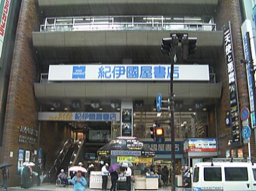
Books Kinokuniya
A Japanese bookstore chain known for large-format stores, Japanese-language books, manga, magazines, stationery, and cultural programming.
Last updated August 21, 2026
AI crawler reads
No AI crawler has read this profile since Oct 28, 2026.
Overview
Books Kinokuniya is the retail bookstore brand operated by Kinokuniya Company Ltd., a Japanese bookseller founded in 1927. The company began in Shinjuku, Tokyo, after Moichi Tanabe transformed a former lumber and charcoal business into a bookstore. From its beginning, the business was conceived as more than a shop: the first store included an art gallery, reflecting Tanabe's view that bookstores should support arts, learning, and public culture. The original Shinjuku premises were destroyed in an air raid in May 1945, but the business reopened later that year and expanded across Japan during the postwar period. Its most prominent Japanese property is the Kinokuniya Building in Shinjuku, completed in 1964. Designed by architect Kunio Maekawa, the nine-story building and two basement levels became a flagship retail and cultural site. Kinokuniya Hall and the Kinokuniya Art Gallery have hosted theatrical, musical, comedic, literary, and other cultural events. The building was recognized as a Tokyo Historic Building in 2017. Kinokuniya developed an international presence beginning with San Francisco in 1969 and Singapore in 1983. It subsequently opened stores in other parts of the United States and across the Asia-Pacific region, including Australia, Taiwan, Indonesia, Malaysia, Thailand, Hong Kong, Vietnam, the Philippines, and Cambodia. It also operates in the United Arab Emirates, where the Dubai Mall location is marketed as Book World by Kinokuniya. Its overseas stores commonly combine Japanese and English-language books with manga, magazines, stationery, gifts, and merchandise connected with Japanese popular culture. The chain is particularly associated with large stores and broad Japanese-language selections. In the United States, its locations have served readers interested in manga, anime-related publications, Japanese novels, art books, design, gaming, and language learning, while also carrying substantial English-language general-interest inventories. Its Singapore presence became known for the scale of the Ngee Ann City store, which for many years was described as one of Southeast Asia's largest bookstores. Kinokuniya's network has also changed over time. Some branches have closed, relocated, or been reduced in size as shopping-center conditions and retail patterns changed. Examples include the closure of the Liang Court store in Singapore in 2019, the closure and later reopening of the Plaza Senayan location in Jakarta, and a planned downsizing of the Ngee Ann City store announced in 2025. The brand remains active as an international bookseller centered on Japanese publishing, cultural discovery, physical retail, and selected lifestyle products.
History
Kinokuniya's roots lie in a lumber and charcoal business in Yotsuya, Tokyo. After the 1923 Great Kanto earthquake, the business moved west to Shinjuku. Moichi Tanabe subsequently refashioned it as a bookstore, opening the first Kinokuniya store in January 1927 with a staff of five. Tanabe selected the name in reference to Kii Province and his family's historical connection with the Kii-Tokugawa family; the company is not descended from the Edo-period merchant Kinokuniya Bunzaemon. The first store reflected an expansive cultural idea of bookselling. It included an art gallery on its second floor, because Tanabe believed that a bookstore should help promote art and culture as well as sell books. The original building was destroyed by fire during an air raid in May 1945. Kinokuniya reopened in December of the same year and resumed expansion during Japan's postwar reconstruction. A major institutional milestone came in 1964, when the Kinokuniya Building was completed in Shinjuku. Designed by Kunio Maekawa, the flagship property provided a large retail space and corporate base while also incorporating cultural facilities. Kinokuniya Hall and the Kinokuniya Art Gallery became associated with performances, exhibitions, lectures, and other cultural activity. The building was designated a Tokyo Historic Building in 2017. The company began international expansion with a San Francisco store in 1969. Singapore followed in 1983, and the chain gradually developed an Asia-Pacific network spanning Taiwan, Indonesia, Malaysia, Thailand, Australia, Hong Kong, Vietnam, the Philippines, and Cambodia. Australia received its first outlet in 1996, initially in Sydney's Neutral Bay before the operation later moved to George Street in Sydney's central business district. In the United States, Kinokuniya stores increasingly combined Japanese and English books with manga and merchandise associated with Japanese television, film, gaming, and popular culture. The former Rockefeller Center store in New York was replaced by a three-level location on Sixth Avenue near Bryant Park. The overseas network has experienced both expansion and contraction. The Liang Court store in Singapore closed in 2019, while other branches in Singapore and Indonesia also closed or changed location. Kinokuniya opened its first Philippine store in 2022 with Fully Booked and added a Central Market PIK 2 outlet in Indonesia in 2023. The Plaza Senayan store in Jakarta, which had closed in 2021, was reported as reopened in December 2024. In February 2025, the company announced plans to downsize its Ngee Ann City store and allocate some vacated area to a cafe. Kinokuniya has also faced reputational criticism. In 2016, trade unions published a document concerning discriminatory hiring practices from the 1980s. Separately, the company was criticized for charging tenants full rent during the COVID-19 pandemic at its San Francisco Japan Center property. These controversies sit alongside the brand's broader identity as a physical cultural retailer: its stores function not only as points of sale but also as venues for discovering Japanese publishing, translated literature, manga, stationery, art, and other cultural products.
- 2022
First Philippine branch opens
[1]The company opened at Mitsukoshi BGC in cooperation with Fully Booked.
- 2017
Kinokuniya Building receives Tokyo Historic Building designation
[1]The Shinjuku flagship property was recognized for its architectural and historical significance.
- 1996
First Australian store opens
[1]Kinokuniya entered Australia through a store in Sydney's Neutral Bay.
- 1983
First Singapore store opens
[1]The Liang Court branch marked the chain's entry into Singapore.
- 1969
First overseas store opens in San Francisco
[1]Kinokuniya began its international store expansion in the United States.
- 1964
Kinokuniya Building completed in Shinjuku
[1]The flagship building, designed by Kunio Maekawa, became a major retail and cultural venue.
- 1945
Original store destroyed and reopened
[1]The Shinjuku store burned during an air raid in May and reopened in December.
- 1927
First Kinokuniya bookstore opens in Shinjuku
[1]Moichi Tanabe opened the first bookstore in January with five employees and an art gallery.
Products and positioning
A premium, culture-led bookstore chain that combines deep Japanese-language selection with international books, manga, stationery, and in-store cultural experiences.
Books
Japanese-language books
Japanese-language books are the chain's defining assortment. Stores typically cover fiction, nonfiction, literature, art, design, business, language learning, children's publishing, and other categories, making Kinokuniya an important source of Japanese publications outside Japan.
Books
Manga and graphic novels
Manga is a major component of Kinokuniya's international proposition. Depending on the market, stores carry Japanese-original editions, English translations, related graphic novels, and adjacent anime, gaming, and popular-culture merchandise.
Books
English-language books
International branches supplement Japanese publications with English-language fiction, nonfiction, children's books, academic titles, art and design books, and general-interest reading. This allows stores to serve both Japanese-speaking customers and local readers.
Stationery and gifts
Stationery and cultural merchandise
Stationery, paper goods, gifts, and selected Japanese cultural merchandise extend the brand beyond conventional bookselling. These products are particularly prominent in overseas locations and complement the chain's manga, art, and lifestyle-oriented assortments.
Cultural venues · 1964
Kinokuniya Hall and Art Gallery
Located in the Shinjuku Kinokuniya Building, these venues support the company's cultural positioning through theatre, comedy, music, exhibitions, and other public programming. They are institutional offerings rather than standard retail products.
Controversies
2016
Historical discriminatory hiring practices
Trade unions published a document concerning discriminatory hiring practices reportedly used by the company in the 1980s. The publication generated criticism and renewed scrutiny of the company's employment history.
San Francisco tenant-rent criticism during COVID-19
Kinokuniya was criticized for continuing to charge tenants full rent at its Japan Center property during the COVID-19 pandemic. Critics argued that the policy placed additional pressure on businesses in San Francisco's historic Japantown.
Brand decisions
2025
Downsize Ngee Ann City storeStrategyBackground
Kinokuniya's long-established Singapore flagship occupied substantial retail space in a changing bookstore and shopping-center environment.
Action taken
The company announced that the store would be downsized, with part of the vacated area reserved for a cafe.
2022
Enter the Philippine market with Fully BookedStrategyBackground
Kinokuniya continued expanding its international presence in Asia through local retail partnerships.
Action taken
The company opened its first Philippine branch at Mitsukoshi BGC in cooperation with Fully Booked.
Aftermath
The Philippine operation later included additional locations in major shopping centers.
2019
Close Liang Court store in SingaporeStrategyBackground
Kinokuniya's Singapore network was undergoing changes in its store portfolio and shopping-center locations.
Action taken
The company announced that the Liang Court outlet would close on April 21, 2019.
Aftermath
The closure reduced the Singapore store network while the Ngee Ann City and other locations continued operating.
Sources2 sources
Cite this profile: Cite the canonical profile. /brand-wiki/books-kinokuniya · Editorial policy · How profiles are compiled