
Auvergne-Rhône-Alpes
A French administrative region created through the merger of Auvergne and Rhône-Alpes.
Last updated August 21, 2026
AI crawler reads
No AI crawler has read this profile since Oct 28, 2026.
Overview
Auvergne-Rhône-Alpes is a landlocked administrative region in south-central and eastern France. It was established through France’s 2014 territorial reform and became operational on 1 January 2016, following the December 2015 regional elections. The region joined the former administrative regions of Auvergne and Rhône-Alpes, creating one of metropolitan France’s largest and most economically significant territorial authorities. The region covers approximately 69,711 square kilometres and contains twelve departments—Ain, Allier, Ardèche, Cantal, Drôme, Haute-Loire, Haute-Savoie, Isère, Loire, Puy-de-Dôme, Rhône and Savoie—along with the Metropolis of Lyon, which has a special institutional status. Lyon is the regional prefecture and principal metropolitan centre. Other important urban centres include Grenoble, Saint-Étienne, Clermont-Ferrand, Chambéry and Annecy. The region also includes extensive rural, volcanic, alpine and pre-alpine landscapes, giving it an unusually varied geographical profile. Its eastern frontier reaches the Alps and borders the Italian regions of Aosta Valley and Piedmont, as well as the Swiss cantons of Geneva, Valais and Vaud. Within France, it borders Bourgogne-Franche-Comté, Centre-Val de Loire, Nouvelle-Aquitaine, Occitanie and Provence-Alpes-Côte d’Azur. The Rhône valley forms a major north-south corridor, while Alpine passes, river valleys and transport links connect the region to Switzerland, Italy and the wider European market. Auvergne-Rhône-Alpes combines the industrial and metropolitan strength historically associated with Rhône-Alpes with the agricultural, volcanic, rural and cultural identities of Auvergne. Its economic base includes advanced manufacturing, chemicals, pharmaceuticals, biotechnology, energy, information technology, transport equipment, food production, agriculture, tourism and winter sports. Lyon is a major centre for business services, life sciences, food industries and international transport. Grenoble is associated with research, electronics, microtechnology, energy and innovation, while Clermont-Ferrand has longstanding links to manufacturing and the tyre industry. Alpine departments support tourism, mountain sports, hospitality and related services. The region’s creation was administratively straightforward but politically and culturally complex. The two predecessor regions had distinct historical identities, economic structures and metropolitan centres. Some local officials and residents objected to the merger or preferred alternative names, including Rhône-Alpes-Auvergne, Alpes-Auvergne and the acronym AURA. After public consultation and debate, the regional council adopted Auvergne-Rhône-Alpes on 23 June 2016. The name was formally confirmed by the French state on 28 September 2016. The region is governed by a 204-member regional council. Its responsibilities include regional economic development, vocational training, secondary-school infrastructure, transport planning, territorial cohesion, environmental policy and support for culture and tourism. The regional authority also promotes a shared identity through a common visual system, coat of arms and flag. Its logo, introduced after the merger, combines visual references to the Alps, Auvergne’s volcanic landscape and the Rhône River. The region remains an active administrative and economic territory rather than a commercial brand in the conventional corporate sense.
History
Auvergne-Rhône-Alpes was created as part of the territorial reorganization enacted by France’s 2014 regional reform. The reform reduced and consolidated the number of metropolitan administrative regions, requiring Auvergne and Rhône-Alpes to form a single regional authority. The new arrangement took effect on 1 January 2016, after regional elections held in December 2015. The merger brought together territories with different historical trajectories. Rhône-Alpes had developed around the Rhône valley, Lyon, Grenoble, Saint-Étienne and the Alpine departments, with a strong industrial, scientific and international orientation. Auvergne was centred on Clermont-Ferrand and the Massif Central, with distinctive volcanic landscapes, agricultural traditions and a more dispersed settlement pattern. Their combination produced a region with major metropolitan areas, internationally connected transport corridors, high mountain areas, rural plateaus and volcanic country. The law initially supplied an interim name formed from the names of the constituent territories in alphabetical order, with the Rhône and Alps included in the compound. The definitive name became a subject of public and political debate. Online polling and consultations considered alternatives such as Rhône-Alpes-Auvergne, Alpes-Auvergne and AURA. Although some consultations indicated support for alternatives, the regional council adopted Auvergne-Rhône-Alpes unanimously on 23 June 2016. The Conseil d’État confirmed the name on 28 September 2016 through a decree published in the Journal officiel. The new regional authority also developed shared symbols intended to reconcile the identities of the merged territories. A coat of arms introduced in 2017 combines heraldic references to Auvergne, Savoie, Lyonnais and Dauphiné. A flag and associated heraldic presentation were formalized during 2018. The region adopted a new visual identity in 2017. Its logo uses a stylized composition evoking the Alpine peaks, the volcanic craters of Auvergne and the Rhône valley. Institutionally, the region is administered by a regional council of 204 members. The council’s functions include economic development, vocational training, regional transport, secondary-school policy, environmental action, tourism and cultural support. Lyon serves as the prefecture and administrative centre, while Grenoble, Saint-Étienne, Clermont-Ferrand, Chambéry and Annecy act as major complementary urban centres. The region’s geography has shaped its modern development. The Rhône corridor supports dense settlement, commerce and transport, while the Alps provide internationally important tourism and mountain economies. The Massif Central contributes agricultural, rural and heritage assets. Lyon–Saint-Exupéry Airport and major rail stations such as Lyon Part-Dieu connect the region with domestic and international destinations. Geneva Airport also serves parts of the Haute-Savoie area. Cross-border links with Switzerland and Italy reinforce the region’s role within the European Alpine space. Since its creation, the region has continued to manage the practical challenge of presenting a coherent territorial strategy across highly varied local economies and identities. Its public identity emphasizes the complementarity of its metropolitan, industrial, agricultural, scientific, cultural and tourism assets rather than a single homogeneous regional character.
- 2018
Flag and heraldic identity formalized
[1]The regional authority formalizes its flag and coat of arms on its website in February 2018.
- 2017
New visual identity introduced
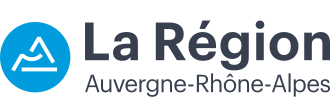
[1]The region adopts a logo representing the Alps, Auvergne’s volcanic landscape and the Rhône River.
- 2017
Regional coat of arms created
[1]A coat of arms combining references to Auvergne, Savoie, Lyonnais and Dauphiné is introduced.
- 2016
Auvergne-Rhône-Alpes becomes operational
[1]The merged administrative region formally begins operating on 1 January 2016.
- 2016
Definitive regional name adopted
[1]The regional council unanimously adopts Auvergne-Rhône-Alpes on 23 June; the name receives formal state approval on 28 September.
- 2015
First regional elections for the merged territory
[1]Regional elections in December 2015 prepare the governing institutions of the newly merged region.
- 2014
Territorial reform establishes the merger framework
[1]France’s territorial reform provides for the consolidation of Auvergne and Rhône-Alpes into a new metropolitan administrative region.
Products and positioning
A large, economically diverse French region positioned around the combination of metropolitan innovation, industrial capability, Alpine tourism, Auvergne heritage and cross-border European connectivity.
Public administration · 2016
Regional public administration
The region provides and coordinates statutory public functions assigned to French regional authorities. These include economic development, vocational training, regional planning, transport policy, environmental initiatives and support for cultural and tourism activities. It operates through the regional council and associated administrative services rather than through commercial product sales.
Transport and mobility · 2016
Regional transport programs
Auvergne-Rhône-Alpes plans and supports regional mobility, including rail and other public-transport services linking its metropolitan, rural and Alpine territories. Lyon Part-Dieu, Lyon Perrache, Grenoble, Saint-Étienne-Châteaucreux, Valence, Chambéry, Clermont-Ferrand and Alpine stations form part of the region’s important transport network.
Tourism · 2016
Regional tourism promotion
The region promotes a broad tourism offer spanning the French Alps, winter and summer mountain activities, the Rhône valley, lakes, historic cities, Auvergne’s volcanic landscapes and rural heritage. The offer is deliberately diverse because the region encompasses alpine resorts, major urban destinations, thermal and heritage sites, agricultural areas and protected landscapes.
Economic development · 2016
Economic development and training support
Regional programs support businesses, innovation, skills development and employment through economic-development policy and vocational training. The underlying economic base includes manufacturing, life sciences, digital technology, energy, food production, agriculture, logistics and tourism, with Lyon and Grenoble acting as major innovation and business centres.
Brand decisions
2017
Adoption of a unified regional visual identityStrategyBackground
The newly merged region needed a common public identity capable of representing territories with different historical, geographical and cultural traditions.
Action taken
The region introduced a logo combining symbolic references to the Alpine peaks, Auvergne’s volcanic forms and the Rhône River.
Aftermath
The visual system became the principal contemporary identity used by the regional authority after the merger.
2016
Adoption of the definitive regional nameStrategyBackground
The territorial merger required the new region to select a permanent name. Public consultations and opinion polling considered several alternatives, including Rhône-Alpes-Auvergne, Alpes-Auvergne and AURA.
Action taken
The regional council voted unanimously on 23 June 2016 to retain Auvergne-Rhône-Alpes. The Conseil d’État formalized the decision on 28 September 2016.
Aftermath
The name became the official designation of the merged administrative region, despite earlier public support for some alternative formulations.
Sources1 sources
Cite this profile: Cite the canonical profile. /brand-wiki/auvergne-rhône-alpes · Editorial policy · How profiles are compiled