

"Build authority" is the most expensive vague advice in marketing.
In AI search, authority is concrete enough to measure: when models must be brief and careful, which sources and entities do they lean on? AEO Intelligence tracks authority-related signals alongside visibility and sentiment.
Authority is a property of evidence, not adjectives
Claiming leadership does nothing. Authority-like behavior in answers usually follows:
- Repeated, consistent entity naming
- Specs and definitions that are easy to quote
- Third-party corroboration that matches first-party truth
- Fewer factual conflicts across the open web
- Citations that survive from week to week
If your "authority campaign" produces only vibe videos, models may still cite a boring documentation page from a peer. That is the citation economy in plain sight—see The Citation Economy.
Practical authority signals to invest in
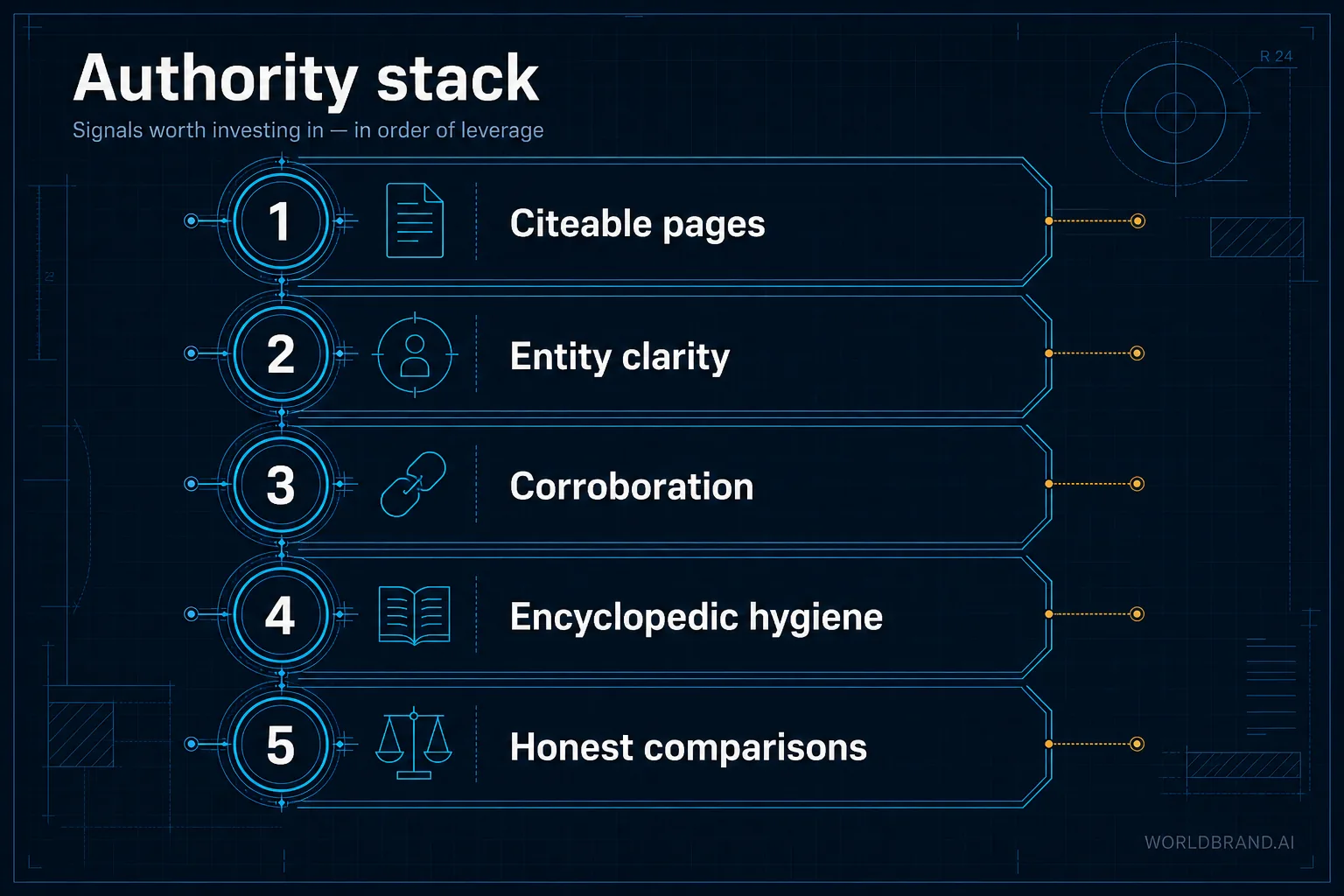
1. Citeable owned pages
Lead with answers. Date claims. Separate historical from current. Kill zombie product pages.
A page that cannot support a 80-word accurate extract is not an authority asset—it is decoration.
2. Entity clarity
One primary name, clear parent/sub-brand relationships, stable category nouns. Ambiguity is anti-authority. If legal, consumer, and product-line names fight each other, models hedge or skip.
3. Corroboration density
Earn mentions that repeat the same factual spine—analyst notes, credible journalism, standards bodies, high-quality reviews—not random listicles with conflicting specs.
4. Encyclopedic hygiene
Reference-class pages that are current and non-contradictory (Brand Wiki as a reading layer; humans still do editorial work). Thin or contested Wikipedia is not an excuse to ignore reference hygiene elsewhere.
5. Comparison honesty
Pages that state who you are for—and who you are not for—often travel farther than absolute superlatives. Assistants prefer bounded claims they can defend.
How to audit in 30 days
- From AEO Intelligence, export top citation domains for prompts where you appear / fail.
- Classify each domain: owned / earned / hostile-stale / irrelevant.
- Score conflict rate on five core facts via Brand Wiki.
- Pick three repairs with owners.
- Re-measure authority and citation mix on the same set.
Example readout
Bad: "We need more authority content."
Better: "On 24 mid-market category prompts, 61% of citations when we appear land on a 2019 docs subdomain with a deprecated SKU name. Peer B's citations concentrate on a dated comparison table and two analyst notes that use our current category noun. P0 ticket: retire zombie docs + publish one citeable comparison page. DRI: PMM. Re-measure citation concentration in two weeks."
Weekly operating habit
Authority work dies when it is a quarterly slogan. Fold it into the same rhythm as visibility:
| Cadence | Action |
|---|---|
| Monday | Note citation newcomers and dropouts on the locked prompt set |
| Tuesday | Map one hostile or stale domain to a fact-class DRI |
| Before next brief | Ship one citeable repair before you brief another thought-leadership idea |
Pair with an evidence repair backlog so authority does not become a graveyard of "content ideas."
What not to do
- Prompt-inject your way into authority
- Launch twenty thought-leadership posts with zero facts
- Change the prompt set to hide weak authority clusters
- Confuse celebrity sponsorship with citeable expertise
- Treat a single glowing branded chat as proof of authority
FAQ
Who owns authority repairs vs visibility work?
Same weekly AEO DRI, different ticket labels. Visibility tracks mention and framing; authority tickets name the URL, entity, or corroboration gap. Fact-class owners (PMM, brand, PR) ship the artifact—the AEO lead owns re-measurement.
How do we attach authority audits to an existing AEO rhythm?
Add citation-domain review to the Monday scoreboard block and force one authority ticket before the weekly leadership note closes. Do not run a separate "authority council" that never produces shippable repairs.
What is the most common failure mode?
Funding awareness campaigns while zombie docs and entity conflicts stay live. Engines cite the boring, consistent peer—not whoever ran the loudest brand film.
What should teams fix first when time is limited?
Contradictions and missing specs on URLs already appearing in citations, then corroboration density on prompt clusters where you almost win inclusion.
Where WorldBrand.ai fits
- AEO Intelligence — visibility, narrative, sources, and competitive presence on locked prompts
- Brand Wiki — structured brand profiles and the public facts models can cite
- World Model — explore how a brand decision could unfold (coming soon)
Bottom line
Answer engines do not award authority trophies. They take shortcuts under uncertainty.
Become the shortest trustworthy path: clear entities, quote-ready pages, corroborated facts. That is authority you can operate—not just pronounce.